White-Label App Builder for Agencies: Offer Mobile Apps Under Your Brand
TL;DR
Most agencies outsource mobile app development or turn down app projects entirely. A white-label app builder lets you offer native iOS, Android, and Windows apps under your own brand — no mobile dev team needed. This guide covers the business model, feature checklist, pricing strategy, and ROI math for agencies adding app services.
The Agency Problem: Clients Want Apps, You Build Websites
Here's a scenario every agency knows: you just delivered a beautiful responsive website. The client is thrilled. Then they ask, "Can you also build us a mobile app?"
Most agencies face three options:
- Say no — and lose the extra revenue (plus risk losing the client to a full-service competitor)
- Outsource to a dev shop — margins shrink, timelines slip, quality is unpredictable
- Hire mobile developers — $120K+/year per developer before they ship a single app
None of these are great. But there's a fourth option that more agencies are discovering: use a white-label app builder to offer mobile apps under your own brand.
What Is a White-Label App Builder?
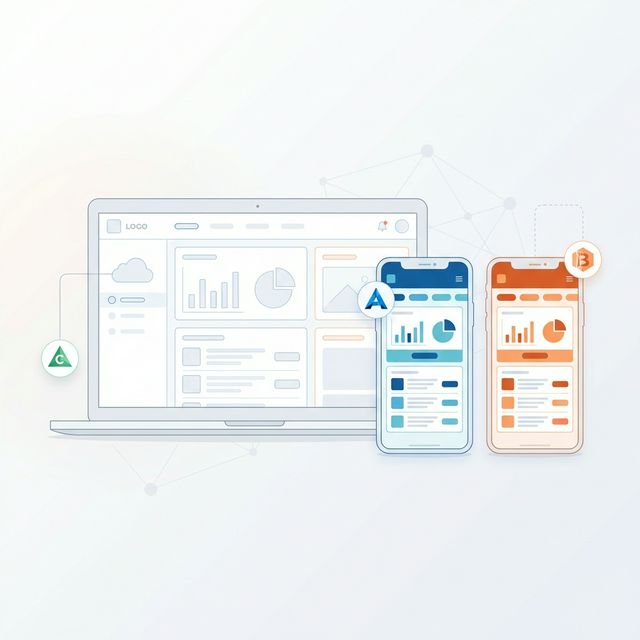
A white-label app builder is a platform that lets you create native mobile apps — but with your agency's branding instead of the platform's. Your clients never see the underlying tool. To them, it looks like you built the app from scratch.
Key white-label features include:
- Custom branding — your logo, colors, and domain on all client-facing surfaces
- Source code export — deliver the full project source to clients who need it
- No "built with X" watermarks — clean, professional output
- OTA distribution — send test builds to clients via your own branded install page
- Multi-platform output — iOS, Android, and Windows from a single build
The Business Case: ROI Math for Agencies
Let's look at the economics. Assume you charge clients $2,000–5,000 for a "native app package" (which is very reasonable — most clients expect $10K+).
| Metric | DIY / Outsource | White-Label Builder |
|---|---|---|
| Your cost per app | $3,000–8,000 | $99–299/mo (platform) |
| Client charge | $8,000–15,000 | $2,000–5,000 |
| Margin per project | 40–50% | 85–95% |
| Delivery time | 4–8 weeks | 1–3 days |
| Ongoing maintenance | Your problem | Platform handles updates |
| Can you scale? | Limited by devs | Unlimited |
If you sign just 5 app clients per month at $3,000 each, that's $15,000/month in new revenue with a ~90% margin. Over a year, that's $180,000 in high-margin revenue — from a service that takes days, not months, to deliver.
What to Look for in a White-Label App Builder
Not all app builders support white-labeling. Here's the checklist we recommend:
Must-Have Features
- Complete brand removal — no watermarks, no "powered by" footer, no brand mentions in the app or store listing
- Custom domain for client portals — clients install test builds from your domain, not the platform's
- Source code access — some clients (especially enterprise) will demand it. You need to be able to hand over a complete Xcode/Android Studio project
- Multi-platform builds — iOS + Android at minimum. Windows is a bonus for enterprise clients
- Cloud-based builds — you shouldn't need a Mac to build iOS apps. The platform should handle code signing, provisioning profiles, and compilation in the cloud
Nice-to-Have Features
- Push notification support — clients always ask for it. Built-in is much better than integrating a third-party service
- Biometric login — Face ID and fingerprint support makes your apps feel truly native
- Offline mode — especially important for retail and field service clients
- Deep linking — for marketing campaigns and SEO
- App Store submission guidance — Google Play and Apple have specific requirements for WebView-based apps. A good platform helps you navigate these
How to Package App Building as an Agency Service
The key is positioning. Don't sell "we'll wrap your website in an app." That sounds cheap. Instead, sell the outcome:
Tier 1: Mobile App Launch Package ($2,000–3,000)
- Native Android app (APK + Play Store submission)
- Custom app icon and splash screen
- Push notification setup
- 3 months of maintenance
Tier 2: Full Mobile Presence ($4,000–6,000)
- Everything in Tier 1
- iOS app (App Store submission included)
- Biometric login integration
- Offline caching
- 6 months of maintenance
Tier 3: Enterprise App Suite ($8,000–12,000)
- Everything in Tier 2
- Windows desktop app
- Full source code delivery
- Custom branding with enterprise code signing
- OTA distribution for internal testing
- 12 months of priority support
Notice the margins: your actual cost (the platform subscription) stays flat regardless of which tier the client picks. The higher tiers are mostly about toggling features — not more work for you.
Common Concerns (And How to Address Them)
"Will clients know it's not custom-built?"
No. With proper white-labeling, the app is indistinguishable from a custom build. The app uses the client's brand colors, icon, and splash screen. There are no third-party watermarks. The source code, if exported, is a standard Android Studio or Xcode project — exactly what a custom developer would produce.
"What about App Store rejection?"
This is the biggest concern, and it's legitimate. Apple specifically scrutinizes WebView-based apps under Guideline 4.2. The key is adding native functionality — push notifications, biometric login, offline mode, deep links — so the app provides value beyond what Safari offers. A good white-label platform builds these in automatically.
"How do I handle ongoing maintenance?"
This is actually where the recurring revenue comes in. Charge a monthly retainer ($50–200/month) for:
- OS compatibility updates (when Apple or Google release new OS versions)
- Push notification management
- App Store listing optimization
- Rebuilds when the client updates their website
Your platform handles the actual technical updates. You're charging for the service layer.
Real Numbers: How One Agency Added $240K/Year
A web design agency with 8 employees added mobile app services using a white-label builder. Here's their first-year breakdown:
| Quarter | App Projects | Avg. Price | Revenue |
|---|---|---|---|
| Q1 (ramp-up) | 3 | $2,500 | $7,500 |
| Q2 | 8 | $3,200 | $25,600 |
| Q3 | 15 | $4,000 | $60,000 |
| Q4 (+ retainers) | 20 | $4,500 | $90,000 + $7,200 retainers |
| Total Year 1 | 46 | — | $190,300 |
By year two, with the retainer base growing and higher-tier packages, they projected $240K+ from app services alone — with zero additional headcount.
Getting Started: Step by Step
- Sign up for an Agency-tier account — this unlocks white-labeling, source code export, Windows builds, and OTA distribution
- Configure your white-label settings — upload your agency logo, set brand colors, and configure your custom domain
- Build your first demo app — convert your own agency website into an app. Use this as your sales demo
- Create a service page — add "Mobile App Development" to your website. Link to your demo
- Upsell existing clients — your best leads are clients who already trust you. Email your client list with the new offering
FAQ
How many apps can I build on an Agency plan?
Unlimited. There are no build count restrictions on the Agency tier. You can build as many apps for as many clients as you want, with no cooldown between builds.
Can my clients manage their own app updates?
Since the app loads from their website, any website changes are reflected in the app immediately — no rebuild needed. For native feature changes (new push notification campaigns, icon updates), you can trigger a rebuild from the dashboard.
What if a client wants to leave my agency?
With source code export, you can hand over the complete native project (Xcode + Android Studio). The client can maintain it independently or hire another developer. This actually makes your offering more attractive — clients aren't locked in.
Do I need mobile development experience?
No. The platform handles compilation, code signing, and app store compliance. If you can configure a WordPress plugin, you can build a native app. The build wizard guides you through every step.
What platforms are supported?
Android (APK/AAB for Google Play), iOS (IPA for App Store), and Windows (EXE for desktop distribution). All three platforms are included on the Agency tier at no extra cost.
Code2Native Engineering
Engineering team
Written by the Code2Native engineering team — the people who build and operate the cloud build pipeline.